Biceps Tendonitis & SLAP Lesions: The “Hidden” Source of Anterior Pain

Biceps Tendonitis & SLAP Lesions: The “Hidden” Source of Anterior Pain
At a Glance
Pain at the front of the shoulder is frequently attributed to the long head of the biceps tendon or a SLAP (Superior Labrum Anterior to Posterior) lesion. These conditions often coexist, representing a spectrum of “traction” or “overuse” injuries that require precise clinical triage to determine if the path forward is rehabilitative or surgical.
The ESP Perspective (The Sixth Sense)
In the Ontario triage environment, we often see patients frustrated by MRI reports showing “mild signal change” or “fraying” of the labrum. The ESP “Sixth Sense” involves looking past the static image to assess the Long Head of the Biceps (LHB) as a dynamic stabilizer.
Clinical Insight: Many SLAP lesions are “incidentalomas”—age-related changes that appear on MRIs but don’t actually cause the patient’s pain. Our role is to determine if the pain is truly “labral” (mechanical clicking and deep instability) or if the biceps tendon is simply exhausted from overcompensating for a weak rotator cuff. True SLAP pain is often felt deep inside the joint, whereas biceps tendinopathy is localized and tender to the touch at the very front of the shoulder.
Anatomy & Mechanics
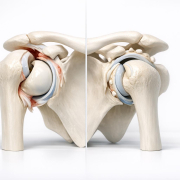
The shoulder is a “ball and socket” joint where the socket (glenoid) is shallow. The Labrum is a ring of cartilage that deepens this socket.
- The SLAP Region: The Long Head of the Biceps tendon attaches directly to the top (superior) part of the labrum.
- The Peel-Back Mechanism: In overhead athletes or workers, repetitive throwing or reaching can “peel” the labrum away from the bone, creating a SLAP lesion.
- Biceps Tendonitis: This is typically an irritation of the tendon as it travels through the “bicipital groove” at the front of the humerus.
The Triage Roadmap
Red Flags
- Acute Deformity: A “Popeye” muscle appearance (suggesting a complete rupture of the LHB).
- Systemic Signs: Fever or unexplained weight loss associated with joint pain.
- Neurological Deficits: Significant weakness or numbness extending down the arm to the hand.
Surgical Indicators
Surgery (typically a Biceps Tenodesis or, more rarely in older populations, a SLAP repair) is considered when:
- Mechanical symptoms (locking, catching, or “giving way”) interfere with daily life or sports.
- The patient has failed 3–6 months of high-quality, targeted physiotherapy.
- The patient is a high-level overhead athlete or manual laborer whose livelihood depends on “biceps-heavy” activities.
The Conservative Path
In Ontario’s Rapid Access Clinic (RAC) model, we prioritize evidence-based rehab:
- Scapular Dyskinesis Correction: Training the shoulder blade to move correctly to take the tension off the biceps.
- Posterior Capsule Stretching: Improving internal rotation to reduce the “peel-back” force on the labrum.
- Kinetic Chain Integration: Ensuring the core and hips are providing the power for movement, so the shoulder doesn’t have to work overtime.
Imaging Expectations
- X-Ray: Usually normal, but essential to rule out arthritis or “bone spurs” in the bicipital groove.
- Ultrasound: Highly effective in Ontario clinics for identifying fluid around the biceps tendon (tenosynovitis) or partial tears.
- MRI / MR Arthrogram: The “Gold Standard” for SLAP lesions. However, we caution patients that many SLAP tears identified on MRI in patients over 40 are considered “normal wear and tear” and may not require surgery.
Interdisciplinary Outcome
At ESPClinics.com, we act as the bridge. If your clinical presentation suggests a mechanical SLAP lesion that isn’t responding to rehab, the ESP will facilitate a direct consultation with an Orthopedic Surgeon specialized in shoulder arthrosocpy. If the issue is predominantly “tendinosis,” we coordinate with your primary care team and physiotherapist to optimize a non-operative recovery, avoiding the risks and lengthy recovery times associated with shoulder surgery.