Total Shoulder Arthroplasty (Anatomic): The Gold Standard for Glenohumeral Arthritis

Total Shoulder Arthroplasty (Anatomic): The Gold Standard for Glenohumeral Arthritis
At a Glance
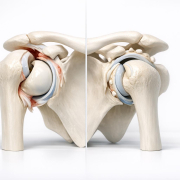
Total Shoulder Arthroplasty (TSA), often referred to as “Anatomic” shoulder replacement, is the definitive surgical intervention for end-stage glenohumeral osteoarthritis where the rotator cuff remains functional. It involves replacing the damaged “ball” (humeral head) and “socket” (glenoid) with prosthetic components to restore smooth mechanics and eliminate bone-on-bone pain.
Clinical Insight: The ESP Perspective (The Sixth Sense)
In the Ontario triage environment, we often see a “discordance” between imaging and function. A “Sixth Sense” practitioner looks beyond the X-ray showing joint space narrowing and focuses on subscapularis integrity and glenoid bone stock.
The clinical pearl often missed by generalists is that an anatomic TSA is only as good as the muscles surrounding it. If the patient has a massive, irreparable rotator cuff tear, an anatomic replacement will fail (leading to “superior migration” of the humeral head). We aren’t just replacing a joint; we are auditing the biological engine that drives it. If the engine (the cuff) is dead, we change the blueprint entirely to a Reverse Shoulder Arthroplasty.
Anatomy & Mechanics
In a healthy shoulder, the large humeral head rotates against a shallow glenoid. In Anatomic TSA:
- The Humeral Component: A metal alloy stem or “stemless” fixative is topped with a highly polished metal ball.
- The Glenoid Component: A high-density polyethylene (plastic) socket is cemented into the shoulder blade.
- The Mechanic: By restoring the anatomical radius of curvature, we recreate the original lever arms of the shoulder, allowing the rotator cuff to once again move the arm without the friction of arthritic “nooks and crannies.”
The Triage Roadmap
Red Flags (Immediate Referral)
While osteoarthritis is chronic, certain signs require urgent orthopedic or ER assessment:
- Infection Signs: Redness, warmth, or drainage in a shoulder that previously had surgery.
- Sudden Neurovascular Change: New onset of “dead arm” sensation or loss of pulse at the wrist.
- Rapid Bone Destruction: Seen on X-ray, which may suggest a neuropathic (Charcot) joint or underlying malignancy rather than simple wear-and-tear.
Surgical Indicators
We transition a patient from the ESP pathway to the Surgical Consultation when:
- Night Pain: The inability to sleep due to deep, boring ache that fails to respond to NSAIDs.
- Functional Ceiling: The patient can no longer perform Activities of Daily Living (ADLs) despite 3-6 months of high-quality physiotherapy.
- Bone-on-Bone Radiographics: Grade III or IV Kellgren-Lawrence changes on a weight-bearing Axillary view.
Conservative Path (The Pre-Hab Phase)
In Ontario’s Rapid Access Clinic (RAC) model, surgery is rarely the first step. Evidence-based conservative management includes:
- Deltoid & Periscapular Sequestration: Strengthening the “secondary movers” to offload the joint.
- Intra-articular Injections: Corticosteroid or Viscosupplementation (Hyaluronic Acid) to provide a “window of relief” for active rehab.
- Range of Motion Maintenance: Preventing capsular contracture (Frozen Shoulder) which complicates the surgical recovery.
Imaging Expectations: Reading Between the Lines
- X-Ray (True AP, Lateral, and Axillary): This is our primary tool. We look specifically for “posterior wear” on the glenoid. If the ball is sitting too far back (B2 glenoid), the surgical complexity increases.
- Ultrasound: Generally poor for arthritis, but the ESP uses it to confirm the Rotator Cuff is intact. If the ultrasound shows a full-thickness supraspinatus tear, the “Anatomic” path is likely closed.
- CT Scan: Surgeons use this for “pre-operative planning” to assess bone density and version (the angle of the socket) for 3D printed guides.
- MRI: Rarely needed for simple arthritis but useful if we suspect Avascular Necrosis (AVN).
Interdisciplinary Outcome: The ESP-Surgeon Partnership
The ESPClinics model streamlines the Ontario patient journey. The ESP performs the heavy lifting of the initial workup—ordering the correct “Arthritis Series” X-rays, assessing cuff strength, and optimizing comorbidities (e.g., BMI, smoking cessation, diabetes control).
When the patient finally sits in front of the Orthopedic Surgeon, the decision is already “vetted.” This partnership ensures that surgical waitlists are reserved for those ready for the OR, while conservative candidates receive specialized, shoulder-specific rehab guidance within the community.